Work in progress. Please come back in the next days.
Bitte besuchen Sie diese Seite bald wieder. Vielen Dank für ihr Interesse!



The following works and case studies demonstrate how TSRDM is applied to industry-agnostic challenges, such as digital transformation, and across different industries to overcome translational gaps.
Digital Transformation
The work: "Service Ecosystem Engineering to Overcome Translational Gaps in Digital Transformation" (Gruhn, V., Warg, M. (2026)

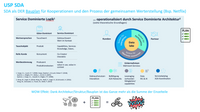
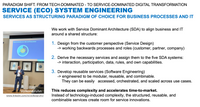
Abstract. Digital transformation initiatives continue to fail at rates between 70% and 95%, as technology‑driven efforts further densify already complex application landscapes instead of translating technological potential into realized value (Koczerga, 2024, Bughin et al., 2019). To systematically address these translational gaps (Sung et al., 2003, Woolf, 2008), this paper introduces Service Ecosystem Engineering (SESE) as a paradigm shift from technology‑dominated to structure‑dominated transformation strategies grounded in the centrality of service (Spohrer et al., 2022) and the Translational Service Research and Design Methodology (Warg et al., 2025). SESE adopts a unifying service language in which service provides the overarching grammar and services act as the primary structuring paradigm. Drawing on Service Dominant Architecture (SDA) as a reference structure, SESE organizes value-creation systems as actors, roles, processes, and services across five systems for interaction,
data, participation, institutions, and operant resources. In doing so, SDA serves both as medium for service design and outcome of software engineering (Gruhn and Striemer, 2018). This SESE approach decouples value-creation systems from specific technologies, and enables pace‑controlled modernization, interoperability, and
ecosystem‑wide value cocreation, helping organizations overcome translational gaps and evolve as learning organizations.

 | Gruhn-Volker_PaperID_117.pptx (7.18MB) |
Financial Services
The work: "Evolving the OVB Service Platform Approach to Overcome the AI Experimentation Trap".
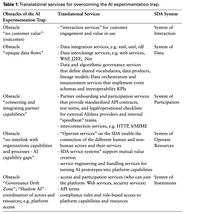
ABSTRACT: OVB, a leading organization in the financial services sector, is proactively leveraging artificial intelligence (AI) to drive innovation and deliver measurable benefits in both customer experience and operational efficiency. During this AI-driven transformation, the company encountered the “AI Experimentation Trap” (Furr and Shipolov, 2025, Huang et al., 2025), the difficulty of converting promising AI prototypes into scalable, compliant, and value-generating solutions. In an era of increasing technological densification, many organizations face similar challenges, compounded by phenomena
such as “Shadow AI” and the “Governance Drift Zone” (Silic et al., 2025). To address these challenges, and particularly to embed AI effectively into OVB’s core processes while maintaining customer relevance, the organization adopts a Service-Dominant (S-D) mindset, treating services as the central structuring paradigm. Complementing
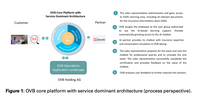
this approach, OVB employs Service Dominant Architecture (SDA), (Spohrer et al., 2022) as enterprise architecture and organizing logic for both its process design and its technical implementation as core platform. This architectural approach enables the seamless integration of AI-enabled services into the broader business ecosystem. The
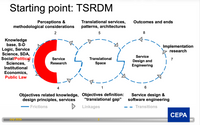
research picked the Translational Service Research and Design Methodology (TSRDM), (Warg et al., 2025) to systematically generate, translate, and apply knowledge that bridges the persistent gap between scientific advances in AI and their practical, value-creating implementation. In this way the work also contributes to the development of the unifying service language of TSRDM.
THE AI EXPERIMENTATION TRAP
The AI experimentation trap (Furr and Shipolov, 2025; Huang et al., 2025) is a strategic failure mode in which organizations rely on widespread AI experiments without anchoring them in clear customer or business outcomes, digital foundations, or scale-up pathways, so that most initiatives remain isolated pilots that consume resources, fragment effort, and ultimately erode confidence in AI’s value. It mirrors earlier “digital transformation” mistakes where a “let 10,000 flowers bloom” approach produced numerous local successes but very few enterprise-level gains. Recent surveys demonstrate that the vast majority of AI initiatives fail to take off and companies are seemingly stuck in proof-of-concept purgatory (Haefner et al., 2023).
Mobility
Media
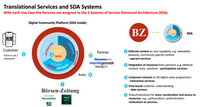
Shaping Börsen-Zeitung: Evolving From Print Media to a Leading Community Platform for Financial Market Decision-Makers
Joachim Lauterbach
WM Gruppe, Börsen-Zeitung, Frankfurt, Germany
Abstract
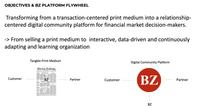
Börsen-Zeitung (BZ), a leading German financial newspaper, is transforming from a transaction-centered print medium into a relationship-centered digital community platform for financial market decision-makers. On its transformation journey BZ
encounters the “media-transformation gap”, understood as the lag between the transformative potential of digital technologies and the value actually realized in media organizations. To develop knowledge and concepts for bridging this gap, the research applies the Translational Service Research and Design Methodology (TSRDM) and adopts a service lens grounded in Service-Dominant Logic, Service Science, and Service Dominant Architecture (Warg et al., 2025, Woolf, 2008, Spohrer et al., 2022).
The findings indicate that by reinterpreting BZ as a service and relationship platform and by structuring offerings as modular services, the organization can reconfigure roles, workflows, and capabilities in a way that editorial content, data, and interaction
services reinforce each other in a “platform flywheel” of engagement and learning.
The work demonstrates how editorial content transforms from a tangible newspaper as output to an adaptive digital value proposition and input into modular offerings like newsletters, podcasts, and community verticals. While customers move from passive readers to active co‑creators interacting on BZ value propositions and resources and thus build momentum for BZ transformation to a data driven, trusted, safety and learning organization continuously enhancing its capacities and capabilities to create (McGowan and Shipley, 2020, Senge, 2006).
Health Prevention & Medicine
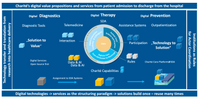
Applying TSRDM Framework to Charité´s Fast Follower IT Strategy - Bridging Translational Gaps of Digital Transformation
Anne-Marie Schneider (CIO, Charité) and Christian Powalla (Head of Governance, Charité)
Abstract
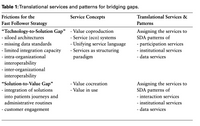
This paper applies the Translational Service Research and Design Methodology (TSRDM) to Charité - University Medicine’s fast‑follower IT strategy, which aims to transform the organization into a digital, connected, adaptive, and learning university hospital. Charité positions digitalization as an enabler for improving care quality, patient experience, and staff relief - not as an end in itself - yet faces pronounced translational gaps between
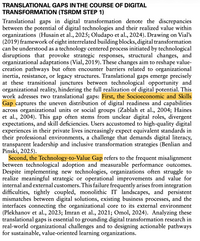
technological potential and realized value in practice. The study conceptualizes two core gaps in Charité’s digital transformation: the “technology‑to‑solution” gap and the “solution‑to‑value” gap. Using TSRDM’s eight‑step process, the research develops a
service‑based knowledge base grounded in Service‑Dominant Logic, Service Science, and Service‑Dominant Architecture. It introduces a unifying service language and SDA‑based patterns that map services onto generic systems of interaction, participation, operant resources, data, and institutions, translating abstract service theory into reusable translational services, design principles, and platform architectures. Findings
demonstrate how TSRDM systematically derives service concepts and translational services that address interoperability challenges for the technology‑to‑solution gap and enhance value‑in‑use, stakeholder engagement, and closed‑loop learning for the solution‑to‑value gap. By operationalizing Charité’s fast‑follower orientation, TSRDM enables the hospital to move from isolated “digital islands” to a scalable portfolio of interoperable, platform‑based digital services that can be rapidly adopted
and adapted across contexts. The study concludes that TSRDM not only analyzes but actively strengthens Charité’s fast‑follower strategy by bridging translational gaps and advancing human‑centered digital innovation and well‑being.
Bridging Translational Gaps in Psychological Care – A Care Platform Approach
Erik Fölting and Jennifer Steinbach
Abstract
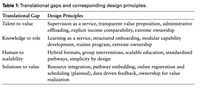
Psychological care systems face increasing demand while struggling to scale access, quality, and impact. Despite strong clinical evidence for the effectiveness of psychotherapy, many organizations encounter structural frictions that prevent available expertise, human resources, and digital solutions from translating into scalable patient value. This paper examines these challenges through the case of Neue Realitäten AG (NRAG), a Swiss provider of psychological diagnostics, psychotherapy, expert opinions for courts or child protection authorities, and clinical supervision. Adopting a design-
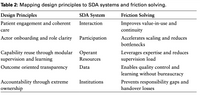
oriented and translational research approach, the study applies the Translational Service Research and Design Methodology (TSRDM) to identify four interrelated translational gaps in psychological care: talent-to-value, knowledge-to-role, human-to-scalability, and solutions-to-value. These gaps are understood as organizational and architectural deficiencies rather than clinical shortcomings. To address these frictions, the paper develops a platform-based psychological care architecture grounded in Service Dominant Architecture (SDA). Psychological care is modeled as an end-to-end service system organized around five organizational capabilities: interaction, participation, operant resources, data, and institutions. A structured care pathway integrates clinical care, supervision, billing, office management, and outcome measurement as constitutive services. The findings illustrate how combining SDA with extreme ownership and architectural simplicity enables clearer accountability, scalable
supervision capacity, and improved observation of value-in-use in real care situations.
The paper offers a transferable design approach for scalable, accountable, and patient-centered psychological care.
Public Sector
Interest
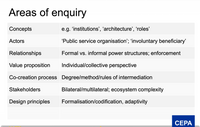
– Contribute to TSRDM evolution by adding public-sector lens
– Facilitate adoption of TSRDM framework in the public sector
Translational Service Research and Design Methodology (TSRDM):
Refining the Public Sector Perspective
Christian M. Stiefmueller & Christine Leitner
Centre for Economics & Public Administration (CEPA)
HSSE Conference, Istanbul, 22 July 2026